Prepare
Use familiar movements at a comfortable pace before a session. Preparation should help a reader notice the body’s current state rather than demand a dramatic change.
Mobility is not a performance of extreme range. It is the practical relationship between range, control, breathing, confidence, and the movement a person wants to use.
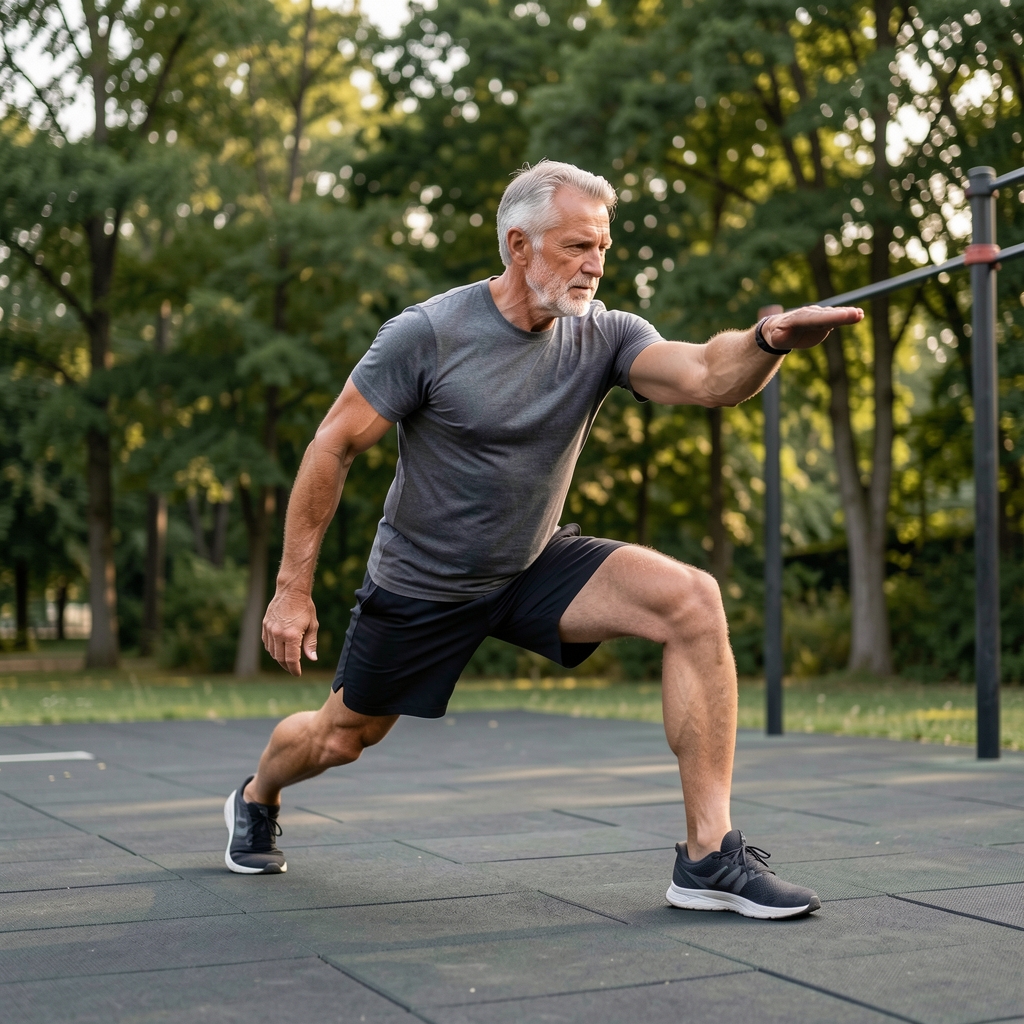
Mobility language is often used broadly. It may refer to the range available at a joint, the ability to control that range, the confidence to move through it, or the preparation needed before a familiar task. These ideas overlap, but they are not identical. A useful explanation says which one it means.
For men over 35, mobility work can be a way to prepare for training, maintain comfort in ordinary tasks, or explore a movement that has become less familiar. It should fit the person and the setting. A controlled, smaller range may be more informative than forcing a larger one, especially when the goal is to understand coordination.
Mobility becomes practical when range serves a movement rather than becoming the movement’s only score.
| Lens | Question | Plain observation |
|---|---|---|
| Range | How far can the movement travel comfortably? | Small, moderate, familiar, or restricted today |
| Control | Can the position be entered and left steadily? | Smooth, cautious, jerky, or needing support |
| Breathing | Can breathing remain relaxed during the movement? | Easy, held, rushed, or interrupted |
| Purpose | What task or session is being prepared? | Walking, lifting, reaching, rotating, or recovery |
Use familiar movements at a comfortable pace before a session. Preparation should help a reader notice the body’s current state rather than demand a dramatic change.
Choose one range and move through it with control. Support, a smaller amplitude, or a slower tempo can make the observation clearer.
Connect the movement to walking, reaching, carrying, or training. A mobility drill is more meaningful when the reader understands why it appears.
Choose a clear purpose and a stable environment. Remove distractions that make balance or attention harder.
Begin with small, familiar movement and notice breathing, comfort, and coordination.
Increase range only while control remains familiar. Stop the experiment if the experience becomes concerning.
Use the movement in the task that gave it purpose, then record what changed and what did not.
Mobility content cannot determine the cause of pain, weakness, instability, or a sudden change. It should not be used to push through a concerning experience. A qualified professional can help interpret an individual situation and identify an appropriate next step.
Mobility connects with strength, endurance, and recovery, but each topic asks a different question. Explore the journal or contact Navlin at Jalan Sudirman No. 18, Senayan, South Jakarta 12190, Indonesia, or +62 21 7123 8945.
Confidence is part of movement quality, but it is not created by forcing a larger position. A reader may gain useful information by reducing the range, slowing the transition, changing the support, or practising in a quieter environment. These adjustments make it easier to distinguish a coordination question from a concern that needs individual attention.
Mobility notes should describe what happened without assigning a cause. “Turning felt less familiar after travel” is a useful observation; it does not establish why. Clear wording leaves room for a professional assessment when needed and prevents a general article from being mistaken for a personal conclusion.